Encounter Atlas Report an encounter

Mysteries / Sounds and signals

The Wow! signal

August 15, 1977 · Big Ear radio telescope, Delaware, Ohio, USA

A 72-second radio burst so strong that an astronomer circled it and wrote 'Wow!'. It never came back.

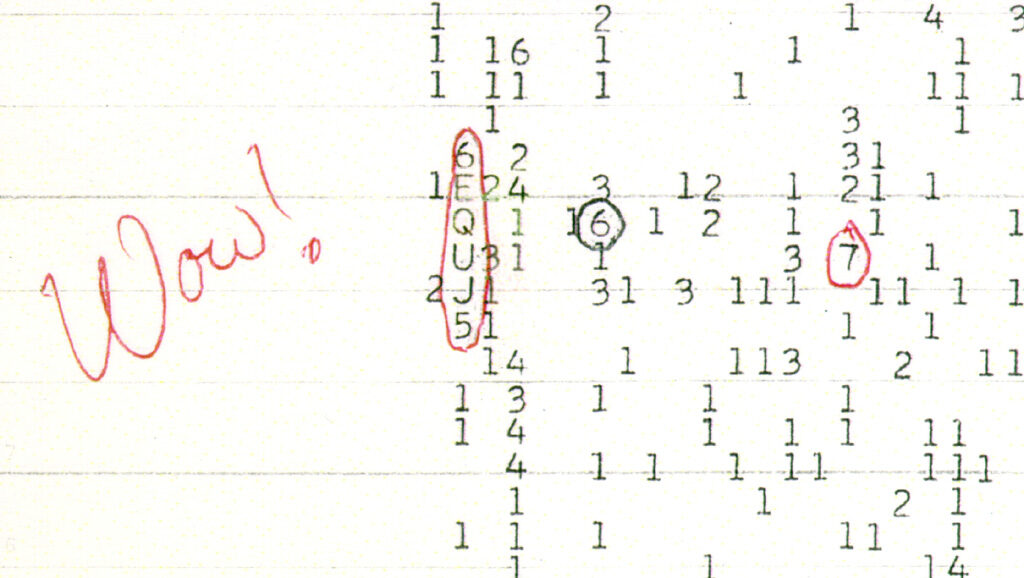
A copy of the 1977 printout with Jerry Ehman's 'Wow!'
A copy of the 1977 printout with Jerry Ehman's 'Wow!'Photo: Big Ear Radio Observatory and North American AstroPhysical Observatory (NAAPO) · Public domain · Wikimedia Commons

On the night of August 15, 1977, Ohio State University's Big Ear radio telescope, then used in the search for extraterrestrial intelligence, picked up a strong, narrow-band radio signal from the direction of the constellation Sagittarius.

Days later, volunteer astronomer Jerry R. Ehman spotted it while reading the computer printouts by hand. He circled the code '6EQUJ5', which showed the signal's strength, and wrote 'Wow!' beside it. The signal lasted the full 72 seconds that Big Ear could watch any one spot, and it was close to 1420 MHz, the natural frequency of hydrogen, where scientists had suggested aliens might choose to transmit.

Despite many follow-up searches, the signal has never been seen again. Ideas have included space debris, comets and rare natural bursts from hydrogen clouds, but none has been confirmed. Big Ear itself was demolished in 1998.

Timeline

  1. August 15, 1977Big Ear records the signal
  2. Days laterJerry Ehman circles it and writes 'Wow!'
  3. 1998Big Ear is demolished

The theories, rated

  • PossibleA rare natural radio burst

    Recent research suggests a sudden brightening of a hydrogen cloud could produce something similar.

  • PossibleA signal from another civilisation

    It matched what SETI was looking for, but a single, unrepeated burst cannot prove it.

  • UnlikelyHydrogen from passing comets

    Proposed in 2016 and criticised by other astronomers.

  • UnlikelyEarth-based interference

    The frequency band is protected and the signal behaved like it came from space.

Sources

All 13 mysteries