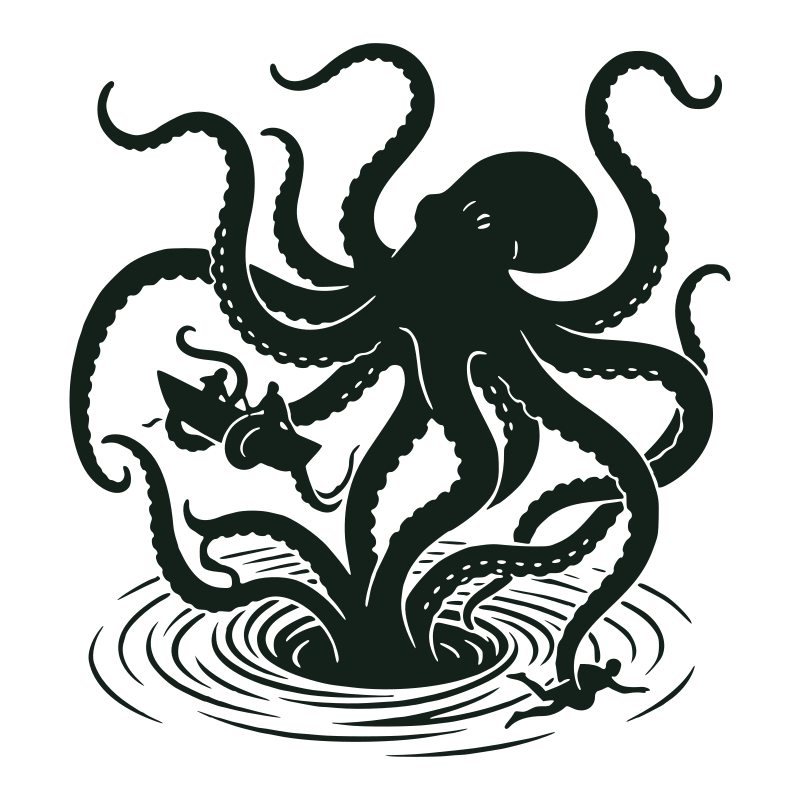
The kraken is a giant, many-armed sea monster of Norwegian sailors' lore. Christen Jensøn's glossary of 1646 describes it pulling boats down into the deep, and in 1729 the missionary Hans Egede equated it with the hafgufa of Icelandic tales. Bishop Erik Pontoppidan of Bergen made it famous in his Natural History of Norway (1752-53): fishermen said that when the sea bed seemed suddenly shallow and full of fish, the kraken lay beneath, and if it rose they had to row away fast before it surfaced like a cluster of small islands. Victor Hugo and Jules Verne later turned it into a fiction staple.
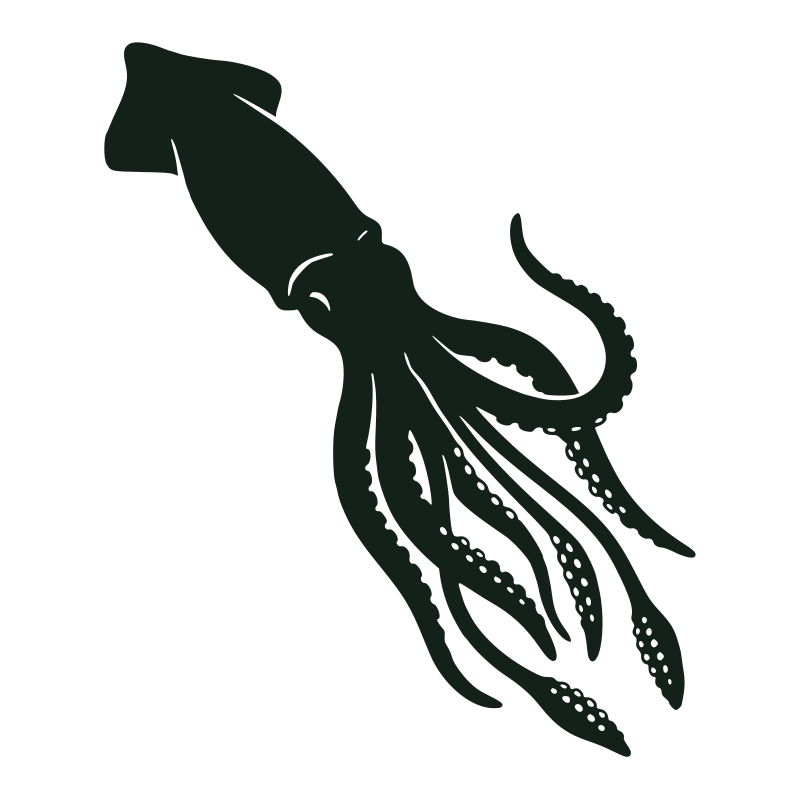
The legend is widely thought to come from the giant squid. Japetus Steenstrup named the genus Architeuthis in 1857, and in the 1870s many giant squid stranded in Newfoundland. In 1873 one reportedly 'attacked' a small boat near Bell Island.
The giant squid is now a known animal, not a cryptid. Females reach about 43 ft including their two long feeding tentacles; claims of 66 ft or more have never been documented. On 30 September 2004 Tsunemi Kubodera and Kyoichi Mori took the first photographs of a live giant squid in the deep sea, about 3,000 ft down off Japan's Ogasawara Islands. In July 2012 a team from NHK and the Discovery Channel, with Kubodera and Edith Widder, filmed one in its natural habitat in the same waters for the first time.
What the stories say
- Huge arms rising beside a boat
- Deep water suddenly sounding shallow over a fishing bank
- Sucker scars on sperm whales
- A dead squid the length of a bus washed ashore
Famous cases
- 1752Pontoppidan describes the kraken in his Natural History of Norway
Bergen, NorwayBishop Erik Pontoppidan of Bergen described the kraken in his Natural History of Norway (1752-53), drawing on fishermen's stories of a creature so vast it could be mistaken for islands. His work spread the kraken legend in the English-speaking world. Modern writers link it to sightings of giant squid.
- 1873Giant squid reportedly attacks a dory
Bell Island, NewfoundlandIn 1873 two men fishing for herring in Conception Bay, Newfoundland, met a huge creature with a beak and long tentacles that spewed ink. Fisherman Theophilus Piccot hacked off tentacles with a hatchet before it escaped, and the evidence helped prove that giant squid are real.
- 2004First photographs of a live giant squid in the deep sea
Ogasawara Islands, JapanOn 30 September 2004 Japanese researchers Tsunemi Kubodera and Kyoichi Mori photographed a live giant squid about 900 metres down off the Ogasawara Islands, using a baited line with a camera. The pictures, released in 2005, were the first of a live giant squid in its natural habitat.
- 2012First video of a giant squid in its natural habitat
Ogasawara Islands, JapanIn July 2012 a team from Japan's NHK and the Discovery Channel, using crewed submersibles near the Ogasawara Islands, filmed a live giant squid about 3 metres long in the deep sea. The footage, aired in early 2013, was the first video of the animal in its natural habitat.
Heard a local story, or had an experience?
Stories passed down in families and communities matter. Share yours in your own words, and you can stay anonymous.